30 Facts About The Panzer IV Tank - The most enduring German Tank in World War II
The fourth and, as it proved, the most enduring of the main types of tank with which Germany rearmed and entered the Second World War was the Panzer IV. The ordnance inventory designation of Panzerkampfwagen IV (PzKpfw IV) or Panzer IV was Sd.Kfz. 161.
Showing posts with label Technical. Show all posts
Showing posts with label Technical. Show all posts
Thursday, October 27, 2016
30 Facts About The Panzer IV Tank – The most enduring German Tank in World War II

Tuesday, August 11, 2015
Cutaway - Pz.IV

In the last model of the Pz. IV, the Ausf. J, the hand crank became almost paramount when the auxiliary engine/generator and power traverse were removed from the tank. To help compensate, the gunner was then supplied with a new manual gearing system to ease the work, but it still took a lot of muscle to rotate the turret with its long gun. Although the coax MG was normally aligned with the main gun and gunner's sights, it could also be elevated independently, and the vision flap on the right side of the mantlet that we saw in an earlier sketch continues to allow the weapon to be visually sighted by the loader. In later vehicles (beginning with the Ausf. F2) this whole system was deemed unnecessary and wouldn't have worked anyway with the revised L/43 gun mount, so the coax MG was fixed in its mount and the small vision flap to the right of the mantlet was finally eliminated.
The Army's Technical Regulations Leaflet 1944 No 256 speaks of the introduction of an "Eastern Front Track" (German: Ostkette) for the Pz Kw IV which increased the overall width to 320.6 cm. In March 1944 the final version of the Pz Kw IV appeared, the Model J. Army Technical Regulations Leaflet 1944 No 184 of 3rd March 1944 states that the electric turret-traversing gear was discarded in this "J" version, and an auxiliary fuel container of 200 litres capacity was built into the engine compartment. The total fuel load was now about 680 litres. At the same time the hand traversing mechanism had to be fitted with a second reduction gear to permit the turret to be turned when the vehicle was travelling on an incline. Some armoured aprons fitted to the sides of this version, consisted of a strong wire netting in place of the usual sheet steel. Rheinmetall-Borsig of Unterliiss were made responsible for the production of the 7.5 cm KwK 40 L/48 which armed the Model H. The vehicles were produced practically until the end of the war in 1945.
Thursday, April 16, 2015
Vorpanzer for the Pz.IV Ausf F1

Vorpanzer F1, with extra bolted appliqué armour on the sides, gun
mantlet and frontal glacis, with the 5th Panzerdivision, Group Center, Russia,
winter 1941-1942.
The most complete story of the Vorpanzer for the PzIV Ausf.F
is in the Band 5 (Neu), Begleitwagen, Panzer IV by W.Spielberger.
Here's a summary:
Conference 7.7.41- The Führer has been informed that in the
battles in North Africa that armour-piercing rounds are becoming a problem from
English tanks. The Führer asks that new production Panzer be equipped w/ spaced
armour in front of the main armour.
Conference 29.11.41- the Fuhrer intends for all unit to be
equipped with the new Vorpanzer.
Report from Krupp-Essen, 24.12.41- There is a shortage of
material for the Vorpanzer... Due to the situation delivery of the first Vorpanzer
is expected on Feb 1, 1942. There is a question, should the turrets be
delivered w/ the Vorpanzer or not, that hasn't been made very clear.
There is more text but is doesn't mention about shipping of
the Vorpanzer to combat units. The idea was dropped with the production of the
Ausf.G with the longer 7.5-cm KwK. There is a photo of 2 PzIV with Vorpanzer,
and the first has the name "Hansi" painted on it. There is no other
markings to distinguish which unit it is. But by the overall look of the rest
of the vehicles it looks like that it is a PzAusbAbt.
Monday, March 30, 2015
Panzer IV Development
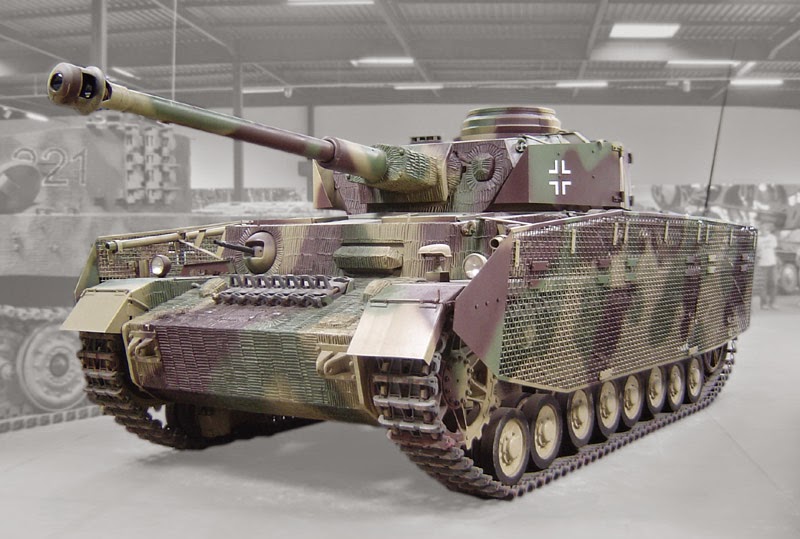
The Panzer IV would remain in production throughout the war.
The most numerous and the most versatile tank the Wehrmacht developed, it is
also usually considered one of the world’s classic armored vehicles, a strong
contender for Top Ten status in any comparative listing. Its origins were
unpretentious. The Weapons Office wanted armaments firms to gain experience
designing and producing heavy tanks. Lutz and Guderian had from early days seen
the need for a support tank. The result was a project for a “battalion
commander’s vehicle” of 24 tons—the bridge weight limit—mounting a 75mm gun,
which was really a howitzer, only 24 calibers long. Dubbed by its crews as the
“cigar butt” and other, cruder names involving length, its high-explosive and
smoke shells were intended to provide for close support—not only for tanks but
for their accompanying infantry. In the war’s early years, however, a
three-inch shell exploding on or near a tank could do significant damage—not
least to crew morale. The Panzer IV would acquire from its early days an
enduring reputation as a formidable opponent.
The Panzer IV suffered from an embryonic armament industry’s
lack of experience producing even moderately large tanks, and from an
increasingly overstrained manufacturing capacity. Only about 200 were on
inventory by September 1, 1939. That was enough, however, to begin allocating a
company to each battalion, and to test the three-to-one combination initially
proposed by Lutz and Guderian. The design withstood prototype testing
admirably. The Panzer IV’s suspension matched its eventual 20-ton weight, and
was so reliable it became standard for all the later versions. Its
superstructure was proportioned generously enough to allow for up-gunning. Its
turret was electrically powered, improving exponentially the chances of getting
off the first shot so often decisive in mobile war. Add standard frontal armor
of up to 50mm, with 20mm on the sides and rear, plus a reliable Maybach engine
giving a top speed of 20 miles per hour and a 100-mile range, and the Panzer IV
was a crew’s delight when it began entering unit service in 1938.
The two-year seesaw conflict across North Africa has been so
often described in so much detail that it is easy to exaggerate its actual
impact on Hitler’s panzers. The campaign involved only three mobile divisions
and never more than around 300 tanks at any one time. Technically the Germans
maintained a consistent, though not overwhelming, superiority—reflecting as
much the flaws in British tank design as the qualities of the German vehicles.
The Panzer III, especially the L version with the 50mm/62-caliber gun, was the
backbone of Rommel’s armor, admirably complemented by the Panzer IV, whose 75mm
shells were highly effective against both unarmored “soft-skinned” vehicles and
unsupported infantry, even when dug in.
The Sherman’s mid-velocity 75mm gun, able to fire both armor
piercing and high-explosive rounds, made it the best tank in North
Africa—except possibly for the later marks of Panzer IV, who brought their even
higher velocity 75mm gun on line in numbers too small—never more than three
dozen—to make a difference.
Replacing the panzers’ material losses was not a simple
one-for-one process. The workhorse Panzer III was increasingly outclassed by
its Soviet opponents—less from any qualitative improvement than because the
Russians were beginning to learn how best to take tactical advantage in
particular of the T-34’s powerful gun and high maneuverability. The Panzer
III’s chassis was too light, its turret ring too small, to be a useful
transition to the next panzer generation. They were issued as stopgaps, and by
mid-1943 appeared in no more than company strength.
The Panzer IV, in contrast, had a future. Improved muzzle
braking enabled it to carry the 43-caliber Tank Gun KwK 40, and a more powerful
48-caliber version introduced in late 1942. More than 1,700 of these F and G
models were produced or upgraded before they gave way in March 1943 to the
definitive late-war Panzer IVH. Its armor was significantly increased: 80mm on
the front and 50mm on the turret, 30mm on the sides and 20mm in the rear—the
latter reflecting Red Army infantrymen and antitank crews’ willingness to come
to close quarters for a kill. The additional protection increased weight to 25
tons and reduced speed to 21 miles per hour, but the Model H could still move
and maneuver well enough. Its 75mm, 48-caliber gun was roughly equivalent to
the T-34’s main armament, and effective against almost anything it could reach.
The Panzer IVH/J integrated a useful set of upgrades into a
state-of-the-art light medium tank, intended to equip one battalion in each
panzer division. More than 3,000 would be built in 1943, and more than 3,100 in
the war’s final 18 months. They were nevertheless regarded as stopgaps, holding
the line for a new generation of exponentially more powerful armored fighting
vehicles.
Sunday, March 29, 2015
Pz Kw IV "Infanterie-Sturm-Steg"


Pz Kw IV "Brückenleger"


Of the Special variants on the Pz Kw IV chassis two are
particularly worthy of mention: the Pz Kw IV "Brückenleger"
(Bridgelayer) and the Pz Kw IV "Infanterie-Sturm-Steg" (Infantry
Assault Footbridge), which were intended for the Tank Engineer Battalions.
Although Army General Orders of 1941 state that the proposed bridge laying
vehicles would be discontinued in the near future because suitable chassis were
not available and could not be produced in the immediate future prototypes of
Pz Kw II and Pz Kw IV bridge layers were built. Individual examples of the Pz
Kw IV Infanterie-Sturm-Steg were however used in France and Russia, mainly for
the capture of strongly fortified defences.
Sixteen Ausf. D chassis were set aside for use as Brückenleger in September 1939. Based on the given month, these were probably the first sixteen chassis produced. They were submitted for approval in March or April 1940. All sixteen were converted to regular tanks during August 1940 and May 1941.
In 1939, having in mind the problems faced when assaulting fixed fortifications, the Waffenamt (Ordnance Department) ordered two Infanterie Sturmsteg built onto Pz Kpfw IV chassis. The bridge was built by Magirus on the same principle as a fire-fighting ladder of approximately 50m. Two bridges placed side-by-side were intended to form beams for a walkway. The two Pz Kpfw IV chassis were from Ausf C production, set aside in August 1939. Delivery of the Sturmsteg took place in February 1940, in time for the campaign in the West.
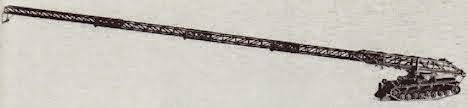

Pz Kw IV "Infanterie-Sturm-Steg"
Subscribe to:
Posts (Atom)